 Our day began with a presentation by Surbana, a 1000-person private developer that also designs public housing projects. Some issues came up from this presentation that put yesterday's experiences of conceptual design into the larger framework of implementation.
Something that came up was the practice of the HDB intentionally keeping public housing quality low to distinguish it from private housing. Although there are many ideas that add elements of choice to public housing projects, few are actually adopted by the Housing Development Board (HDB). If public housing projects offer the same flexibility and options as private housing, then expensive private housing becomes less desirable. Apparently, the way that public housing is priced in relation to private housing hangs in careful balance. At Surbana, an architect showed us a video explaining how a user could interact with a website to make very detailed choices about his unit's configuration, facade, and interior design. HDB would not let this video be shown to users, perhaps because of logistical concerns, perhaps because of other concerns. I find it disappointing that public housing quality could become more but is held back.
I'm still curious about any types of ground up political movements because of dissatisfaction. From talking with the Singaporean students who are helping with the workshop, it seems that citizens acknowledge the same issues with the Singaporean government that we foreigners have noticed. However, from what I know, there have been no organized, bottom-up, citizen-organized movements. The government does a fine job providing materially for its people, but is this enough to make them happy?
Sengkang: Concrete Jungle
In my opinion, the housing development we visited in Sengkang, a new town in Singapore's "suburban" heartland, is like monolithic and imposing. I just saw column after column of high-rise buildings. Residential and commercial uses are separated. It has a sterile feeling because of the design or because of the development's newness and lack of people living in the units. At Sengkang, our assignment was to interview families about their housing situation. Specifically, we wanted to find out their recommendations for future housing.
 New tall residential high rises in Sengkang
My team decided to immediately take the elevator to units with laundry hanging outside to dry since this signals that the families would more likely be home. During our exploration on the seventh floor, we found a unit that was being worked on and asked if we could walk around inside. To me, the units felt surprisingly large (90 square meters); they consisted of three bedrooms, two bathrooms, one living room, one kitchen, and one bomb shelter (Singapore is an island with nowhere to run in the event of a nuclear attack). The units feel cool and are designed with great cross-ventilation.
After looking at the empty flat, we walked up a few levels and peeked our eyes through screen doors. Eventually, an older man was willing to talk to us about what it was like to live in Sengkang. Soon enough, he invited us inside for refreshments and more conversation. He was retired, and his wife sold soya bean drinks at the mall part time. He lived with his sons, who lived on two different stories in the same housing block (sometimes he and his wife stayed with the older son; other times they would stay with the younger). He moved in very recently because his sons were getting married and needed their own units. He liked living in his unit because he had a great view of the green space and because it was conveniently located close to amenities and the MRT station (that's only 22 minutes to Chinatown). He didn't like living in his unit because few of his friends were there, there wasn't too much communal space on upper levels, and the design of the floor gave little opportunity for social interaction.
Toa Payoh: Hoorah for sky gardens
 Lively mall in Toa Payoh
 Sky garden
Our last stop was Toa Payoh, the one of the HDB's first new towns that were located outside of the city center. The area has a very lived-in feel, and the uses are mixed (there are residential units right next to the shopping mall and street shops). After walking through an HDB exhibit, we debriefed on the 12th-story "sky garden" that provided an amazing view overlooking Toa Payoh. We broke into our surveying teams and wrote down the family's impressions of their housing development and our impression of the housing developments. You can see my team's results here:


A few of us took the elevator (the lift) to the 40th story of this residential high rise. The view from here was amazing, too:

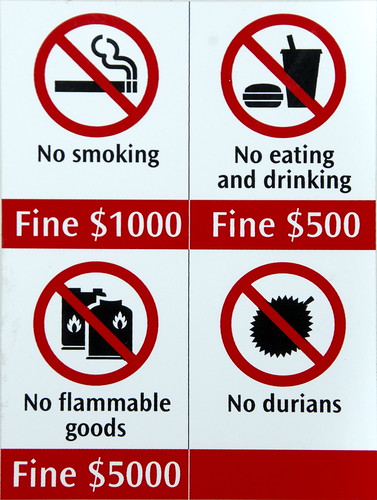
Random: Toon, a Singaporean student, bought some fresh durian for us to try. For most of the MIT students, it was their first time. Interestingly, our hotel floor also smelled like durian when we returned. The government even has laws against durian; for example, you can't bring durian on the subway or else you'll receive an unknown penalty. Here's the sign:

3 comments:
Hi, this is Tim's worried girlfriend. I asked him to give me his itinerary and tell me the name of his new hotel but still haven't heard from him. Do you know which hotel he will be staying at in Bangkok? Thanks, Allie
tee hee i wasn't lying about the durians=) mannnn i think you know more about singapore housing stuff than i do now! it's so exciting that you're visiting all these places - i live in yio chu kang if you know where that is=)
It's not really an unknown penalty - everyone's just gonna beat you up cos of the smell.
Post a Comment